GORLIN SYNDROME (Basal Nevus Cell Carcinoma Syndrome) ⭐IMPORTANT POINTS TO PONDER Gorlin syndrome is an autosomal dominant neurocutaneous (phakomatosis) disease characterized by a triad of multiple...
QUICK EXAM CRACKERS IMPORTANT COMMON TUMOURS Most common malignancy in females in the world – Breast cancer followed by lung cancer Most common malignancy in females in India –...
IMPORTANT ORAL MANIFESTATIONS OF METABOLIC DISORDERS 🔹DIABETES MELLITUS: Severe periodontitis with loosening of teeth, gingivitis and painful gingival, burning mouth syndrome, delayed wound healing...
QUICK EXAM CRACKERS RADIOGRAPHIC CHANGES IN VARIOUS TOOTH ABNORMALITIES 🔺GEMINATION (Incomplete): Two crowns with one root 🔺DILACERATION: Sharp bend in the tooth (mostly root)...
TYPICAL RADIOLOGICAL APPEARANCE CONTD. 🔺Brush in winter appearance: Normal sialographic appearance of submandibular gland 🔺Savage like appearance: Sialographic appearance of Sialographic 🔺Snow storm...
LAMINA-DURA Lamina-dura is a radiographic feature appears as a thin radiopaque line surrounding the roots of the teeth, which represents the alveolar bone proper. Presence of intact lamina-dura around...
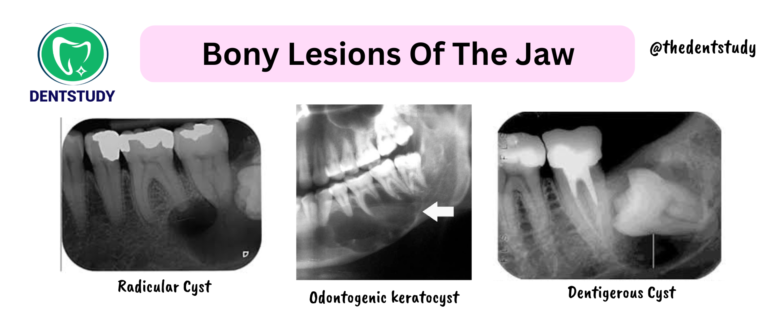
BONY LESIONS OF THE JAWS: 📣 Classification Of Bony Lesions of The Jaws: 1) RADIOLUCENT A) Unilocular B) Multilocular 2) RADIOPAQUE 1) RADIOLUCENT LESIONSA) Unilocular Radiolucent Lesions...