HEAD AND NECK IMPORTANT QUICK NOTES 🔍 INTRODUCTION: The head and neck region houses vital exocrine and endocrine glands that regulate saliva, hormones, tears, and more. These glands are important not...
QUICK REVISION NOTES ON PARANASAL SINUSES 📌 POINTS TO PONDER 🔹Air-filled bony cavities located in the face and skull adjacent to the nose. 🔹Derive their nomenclature from the bones that they...
TOPIC: BASIC INTRODUCTION OF HUMAN BODY ⭐ PRACTICE QUESTION & ANSWER 1. Which of the listed terms is described by: “All the chemical processes that take place in the organelles and cytoplasm of...
OSTEOLOGY OF SKULL 📌 TERMINOLOGY 🔹Canal: A long passage within bone that transits blood vessels and nerves 🔹Foramen: A natural opening or perforation through bone that permits transit of blood...
📌 POINTS TO PONDER 🔹Trochlear (4th) nerve is the only cranial nerve to emerge dorsally from the brain stem& has longest intra cranial course and most slender cranial nerve 🔹The artery that passes...
TOPIC: BASIC INTRODUCTION OF HUMAN BODY ⭐ PRACTICE QUESTION & ANSWER 1. Which of the listed terms is described by: “All the chemical processes that take place in the organelles and cytoplasm of...
Learn the stages of tooth development—from dental lamina to bud, cap, and bell stages—and understand enamel, dentin, pulp, and bone formation. A high-yield guide for NEET MDS, BDS, NBDE/INBDE, and...
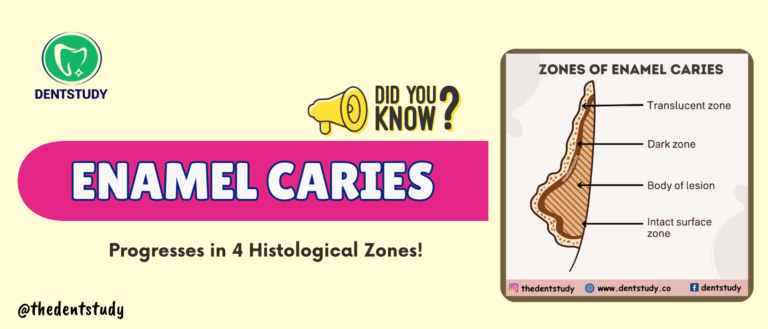
Understand the 4 histological zones of enamel caries—translucent zone, dark zone, body of the lesion, and surface zone—explained with an easy diagram. A high-yield pathology topic for NEET MDS and...
– Conceptual + viva-ready – I. Introduction to Dental Pulp 🔸Soft connective tissue in the center of the tooth 🔸Located in pulp chamber (crown) and root canal 🔸Embryological origin: Central cells of...
TOPIC: AMELOGENESIS, HA CRYSTALS & ENAMEL RODS 🔺Amelogenesis — the process by which enamel, the hardest tissue in the human body, is formed. 🔺The amelogenesis is a tightly regulated, multi-phase...
TOPIC: HISTOPHYSIOLOGY & MOLECULAR INSIGHTS 🔍 What is Histophysiology? 🔸It is the study of tissue structure (histology) along with function (physiology). 🔸In tooth development, it refers to how...
TOPIC: TOOTH DEVELOPMENT & OSTEOGENESIS REVISION NOTES 👉 Tooth development is a highly organized and complex biological process that starts early in embryonic life. It involves a series of...
QUICK REVISION NOTES 📌 Introduction to Osteology 🔸Osteology is the study of bones, which make up the skeletal system. 🔸The adult human skeleton has 206 bones. 🔸These bones are categorized into two...
TOPIC: CLASSIFICATION OF TEETH BASED ON THEIR NORMAL POSITION 📌 KEY POINTS FOR COMPLETE HUMAN DENTITION 🔷 DENTITION: Refers to all the teeth present in the mouth. 🔷 TWO SETS OF DENTITION Types of...
TOPIC: CLINICAL CROWN PREPARATION IN FPD 🎯 KEY POINTS: 🔺Functional cusp bevel is given on the lingual inclines of the maxillary lingual cusps and buccal inclines of the mandibular buccal cusps...
TOPIC: FIXED PARTIAL DENTURE 🎯 KEY POINTS: 🔸Maxillary first molar has maximum root surface area of 433 mm2 and Mandibular first molar has root surface area of 431 mm2; among Anterior maxillary teeth...
TOPIC: DIAGNOSIS AND TREATMENT PLANNING IN FIXED PARTIAL DENTURE 🎯 KEY POINTS: 🔹Xerostomia is common to autoimmune disorders such as Sjogren syndrome, Rheumatoid Arthritis, Lupus Erythematosus and...
INTRODUCTION OF CONNECTORS IN FPD (Fixed Partial Denture) 🎯 KEY POINTS: 🔸Connectors unite the retainers and pontics in an FPD. 🔸Types include rigid and non-rigid connectors. 🔸Rigid connectors provide...
RETAINERS IN FPD 🎯 KEY POINTS: 🔸Retainers are the part of an FPD that attaches to the abutment teeth. 🔸They provide retention and support for the pontic. 🔸Types include full crowns, partial veneer...