
FURCATION INVOLVEMENT IN PERIODONTOLOGY
⚡ High-Yield Summary
Master furcation involvement with these high-yield Periodontology facts for exams. Revise furcation anatomy, furcation entrance and fornix, root separation, hemisection, root amputation and key clinical terms quickly.
TOPIC: FURCATION
📌 POINTS TO PONDER
🔹The dimensions of furcation entrance should be taken into consideration during the selection of instruments.
🔹Furcation defects of maxillary molars are more difficult to interpret on radiographs because of the superimposition of the large palatal root.
🔹In hemisection, two-rooted molar tooth is converted into two single-rooted teeth.
🔹Furcation is the area located between individual rootcones.
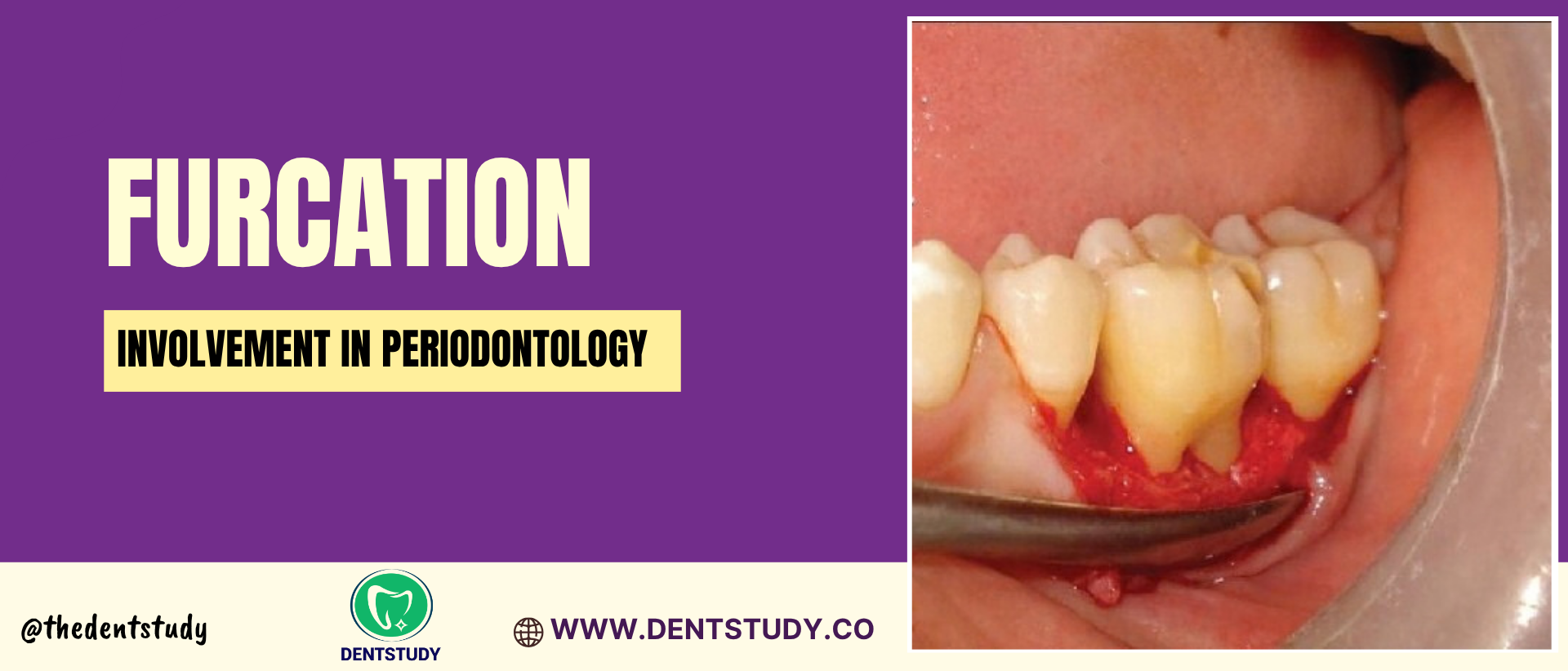
🔹Furcation involvement is the extension of pocket formation into interradicular area of bone of multi-rooted tooth.
🔹Furcation entrance is the transitional area between the undivided and divided part of the root.
🔹Furcation fornix is the roof of the furcation.
🔹Degree of Separation is the angle of separation between two roots (cones).

🔹Co-efficient of Separation is the length of root cones inrelation to the length of root complex.
🔹Root amputation is the removal of one or more roots from a multi-rooted tooth leaving the majority crown intact.
🔹Sectioning is the surgical sectioning of a tooth into segments consisting of the root and overlying crown.
📌 VIVA VOCE
Q1. Why the dimensions of furcation entrance should be taken into consideration during the selection of instruments?
Ans. According to Bower, 81% of furcations of maxillary and mandibular permanent first molar has orifices that are 1 mm or less wide, while in 58% molars, furcation entrance is narrower (0.75 mm or less) than the width of the blade of standard curettes (>0.75 mm).
Q2. From which aspect mesial furcation of maxillary molar is easily probed?
Ans. Mesial furcation of maxillary molar is easily probed from the palatal aspect because mesial furcation opens about two-thirds of the way towards the palate, rather than midway buccolingually.
Q3. What is nonvital and vital root resection?
Ans.
- Nonvital root resection—the endodontic therapy is done prior to root resection.
- Vital root resection—the root resection is accomplished first and then endodontic therapy.
Q4. What is furcation arrow?
Ans. Furcation arrow is a small triangular radiographic shadow noted in the radiographs of maxillary molars over either mesial or distal root in the proximal Class II or III furcation defects.
Q5. Why prognosis of furcation defect of maxillary first premolar is the worst?
Ans. Maxillary first premolar has long root trunk of approx. 8 mm which makes instrumentation at furcation defect much difficult.
Q6. What is furcation entrance?
Ans. It is the transitional area between the undivided and divided part of the root.
Q7. What are the predisposing factors for the furcation involvement?
Ans. Cervical enamel projections; trauma from occlusion; pulpal periodontal disease; iatrogenic cofactors and root fractures involving furcations.
Q8. Which factors should be considered in projecting prognosis of tooth with furcation involvement?
Ans. Extent of involvement; status of bone support; root separation and health of neighboring teeth.
Q9. Who described furcationplasty?
Ans. Hamp, Nyman and Lindhe in 1975.
Q10. How is furcation classified according to Goldman and Cohen?
Ans.
- Grade I: Incipient lesion;
- Grade II : Cul-de-sac lesion;
- Grade III : Through and through lesion.
📌 MULTIPLE CHOICE QUESTIONS MCQs
💡 Furcation lesion can be clinically detected by:
A. Curette
B. Hoe
C. Naber’s probe
D. 17 end explorer
Answer : C
💡Cul de sac lesion is:
A. Grade I furcation
B. Grade II furcation
C. Grade III furcation
D. Grade IV furcation
Answer : B
💡 Hemisection is commonly done in:
A. Maxillary molar
B. Mandibular molar
C. Maxillary premolar
D. None of the above
Answer : B
💡Tunnel preparation is usually done in:
A. Grade I furcation lesion
B. Grade II furcation lesion
C. Grade III and IV furcation lesion
D. None of the above
Answer : C
💡 In vital root resection:
A. Endodontic therapy is done prior to root resection
B. Root resection is done prior to endodontic therapy
C. Endodontic therapy is not done at all
D. None of the above
Answer : B
💡 Indication for vital root amputation during periodontal surgery except:
A. Root fracture
B. External resorption
C. Root anomalies
D. Grade I Furcation defect
Answer : D
💡Prognosis is worst for furcation involvement of:
A. Maxillary 1st premolar
B. Maxillary 2nd premolar
C. Mandibular 1st premolar
D. Mandibular 1st molar
Answer : A
💡 Hemisection is:
A. Removal of one or more roots from a multi-rooted tooth leaving the majority of crown intact
B. Removal of one or more roots from a multi-rooted tooth with the crown
C. Splitting of a two rooted tooth into two separate teeth
D. None of the above
Answer : C